Behind the Quarry — How Natural Stone Goes from Rock Face to Slab
 Team
Team
The Quarry: Where It Begins
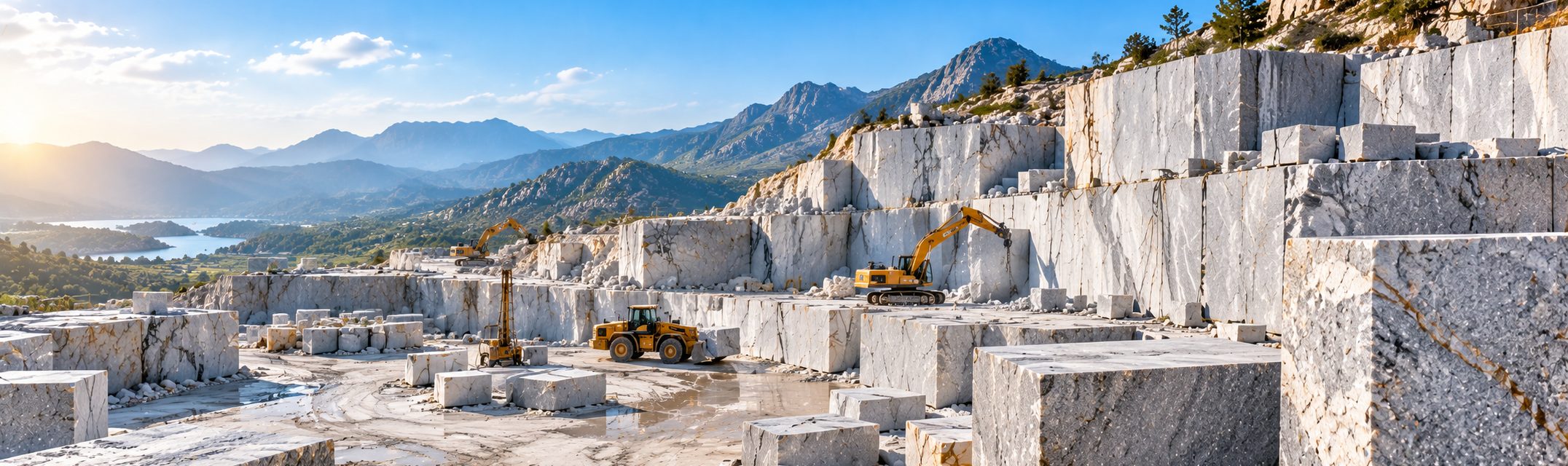
Marble and granite quarrying is fundamentally the extraction of blocks from a mountain. At a marble quarry like those in Carrara, Italy — where quarrying has continued for 2,000+ years — the active quarry face is blasted, wire-sawed, or cut with diamond wire into manageable blocks. A typical commercial block weighs 15–25 tonnes and measures roughly 2×1.5×1.2 metres.
Block quality is critical: fissures, discolouration, or structural weakness in the block will propagate through every slab produced from it. Experienced quarry managers learn to read the rock face — knowing where to cut to maximise yield from premium-quality stone and where to accept lower-grade material.
Gang Saws and Wire Saws: Turning Blocks Into Slabs
Most marble blocks are processed by multi-blade gang saws — large frames holding dozens of steel blades that oscillate through the block simultaneously, cutting up to 60 slabs in a single multi-day pass. The result is a slab bundle: a stack of slabs that remains in original sequence from the block, critically important for bookmatching.
Harder stones like granite require diamond wire saws or frame saws with steel shot. Large-format granite quarries in India and Brazil use these extensively.
Calibration, Polishing, and Finishing
Raw-sawn slabs have a rough, uneven surface. They go through calibration (machine-grinding to a consistent thickness) followed by polishing — multiple passes through increasingly fine abrasive heads until the desired finish is achieved. A standard polished finish typically requires 7–12 polishing heads.
For honed finishes, the process stops before the final high-gloss passes. For leathered/brushed finishes, the slab surface is then treated with diamond brush heads.
Fill, Repair, and Quality Grading
After polishing, slabs go through quality grading. Natural defects — open veins, pitting, cracks — are evaluated. Premium grades export as-is; commercial grades are filled with epoxy or polyester and sold at lower prices. Some suppliers do not disclose filling — a practice buyers should be aware of and guard against by inspecting under raking light.
Container Loading
Slabs are loaded into A-frame wooden crates, typically holding 6–10 slabs per crate, and loaded into 20ft or 40ft containers. Proper loading is critical: inadequately crated stone breaks in transit, and the resulting disputes can be difficult to resolve. Ask your supplier for container loading photos before the vessel departs.
Topics