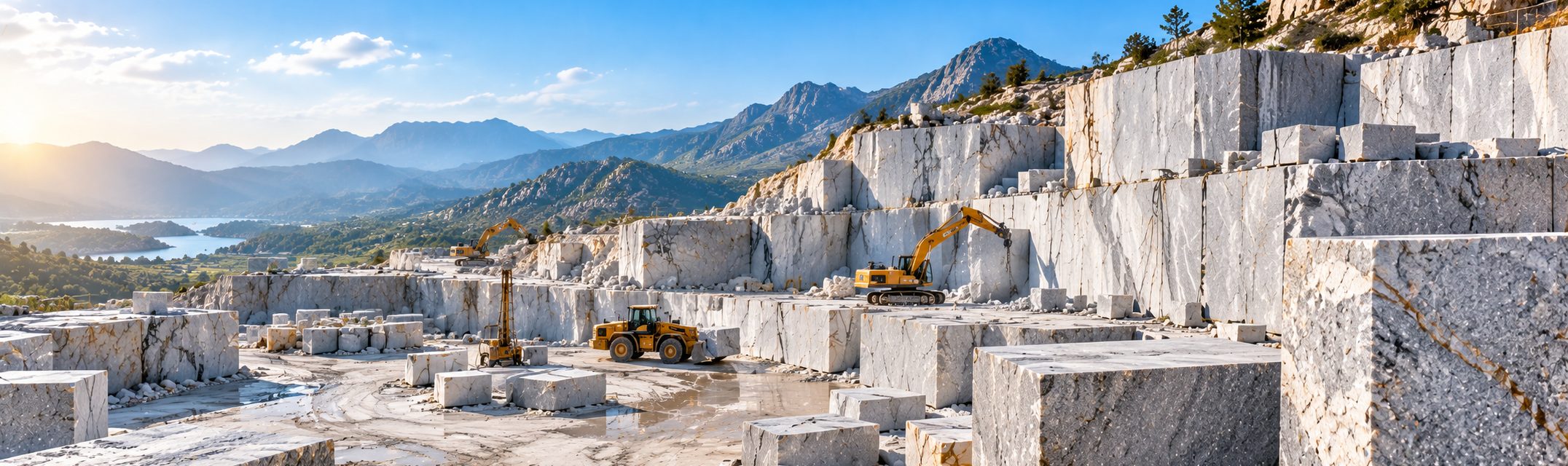
Italian Stone Exports Rise in H1 2026
 Team
TeamExport Performance and Market Trends
Italian exports of natural stone and stone-working technology reached US$1.69 billion during the first half of 2026. This represents a 5.5 percent increase compared to the same period in 2025, according to data from the Confindustria Marmomacchine Studies Centre. The growth was driven primarily by natural stone materials, which accounted for US$1.231 billion of the total, an 8.2 percent increase year on year.
A notable trend in the first half of 2026 was the divergence between export value and physical volume. While the total value of exports rose, the volume of marble, travertine, granite, and other natural stones shipped fell by 3.3 percent to approximately 997,000 tonnes. This indicates that the sector experienced a price-driven gain, with the average export price for natural stone reaching a record US$1,234.6 per tonne. Finished and semi-finished products specifically surpassed the US$2,000 per tonne threshold for the first time.
Key Markets and Trade Dynamics
The United States maintained its position as the largest destination for finished and semi-finished Italian stone, with imports totaling US$323.5 million, a 7.5 percent increase. This performance occurred despite the 2026 tariff environment. In contrast, the raw block market saw China emerge as the dominant destination, absorbing more than 50 percent of Italy's raw block exports. China received US$144.6 million in raw blocks, a 19.5 percent increase, followed by India at US$30.1 million.
Other markets for finished and semi-finished stone showed varied results. Germany remained stable at US$66.3 million, while Switzerland saw significant growth of 27.7 percent to reach US$62.4 million. The UAE also experienced strong demand, with imports rising 24.9 percent to US$41.2 million. Conversely, exports to France declined by 1.7 percent to US$58.1 million. Meanwhile, Italy's exports of stone-working technology and machinery saw a slight decline of 0.9 percent, totaling US$459.2 million.
Implications for Procurement and Supply Chains
The current market conditions require procurement teams to be more diligent regarding the origin and processing of materials. Because China is a major importer of Italian raw blocks, buyers should not assume that stone labeled as Italian-origin was necessarily fabricated in Italy. It is essential to verify processing documentation to ensure the material meets specific project requirements for Italian fabrication.
Furthermore, the record-high pricing for finished Italian stone suggests that buyers should expect limited room for price negotiations. Procurement professionals are advised to establish clear price validity in all quotations. For projects with longer procurement cycles, it may be necessary to include price escalation terms, particularly for processed materials. Additionally, with rising demand in regions like Switzerland and the UAE, securing premium lots early in the buying process is recommended to avoid supply shortages.
Sector Outlook and Trade Balance
Despite a 5.1 percent decline in imports to US$245 million, Italy's overall trade surplus for the sector grew by 7.6 percent to US$1.445 billion. The data highlights a robust export performance for the Italian stone industry, even as technology exports edged lower and natural stone volumes decreased. The record-breaking prices for finished and semi-finished products serve as a new benchmark for buyers comparing Italian fabrication with alternative supply routes. As the industry moves forward, the focus remains on managing supplier capacity and delivery timelines, particularly in the US market, which remains the largest consumer of finished Italian stone.
Key takeaways
- Italian processed stone prices have reached record levels, limiting discount potential for buyers.
- Procurement teams must verify processing origin, as Italian-origin stone is not always fabricated in Italy.
- Rising demand in markets like Switzerland and the UAE is increasing competition for premium stone lots.
- Buyers should consider price escalation clauses for long-term contracts involving processed materials.
Sources
- Italian Stone Exports H1 2026, stonetrades.com, Sep 29, 2026
- Exportações italianas de rochas no 1º sem. de 2026, stonetrades.com, Sep 29, 2026
- Italienische Steinexporte H1 2026, stonetrades.com, Sep 29, 2026
This article was researched and drafted with AI from the sources listed above. Check the original sources before acting on any regulatory detail.
Topics